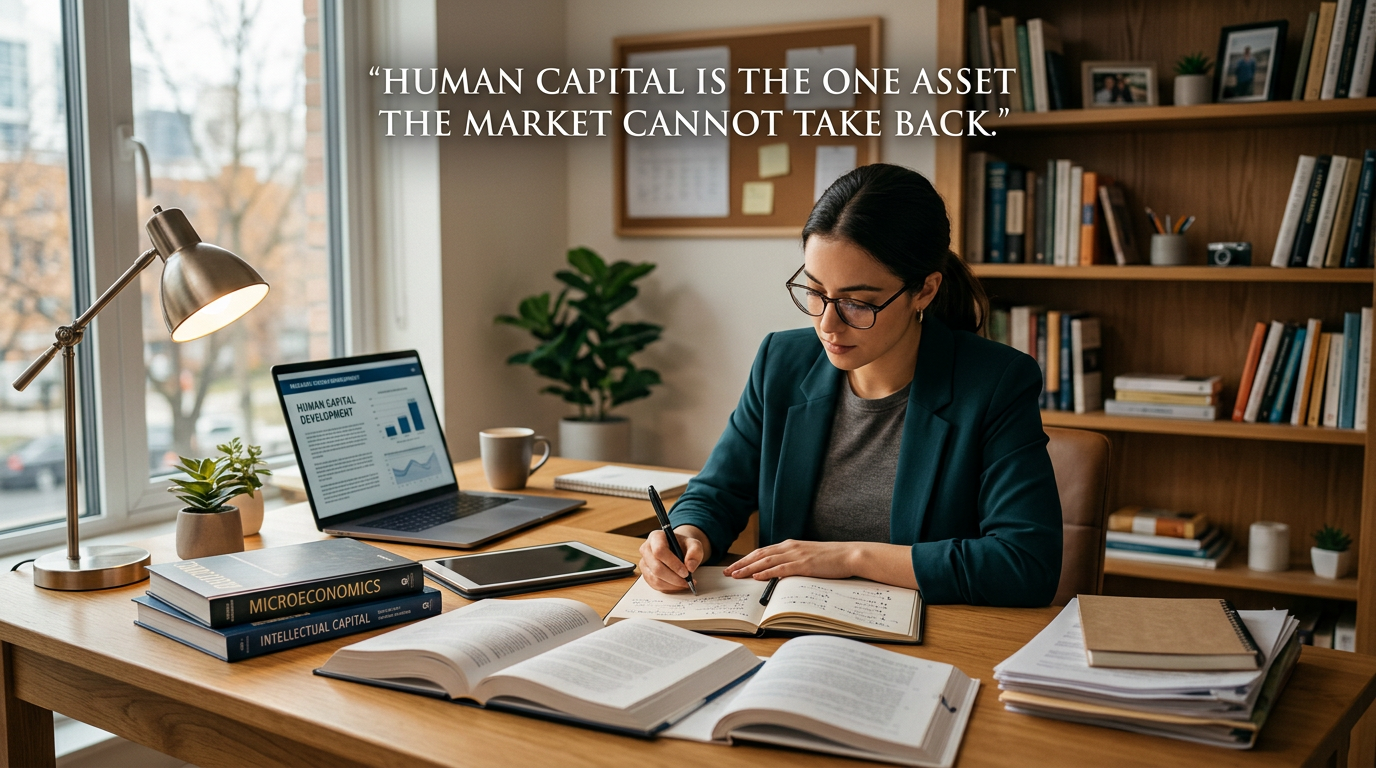
The only asset no market can take back is your human capital: your ability to learn, solve problems, make sound decisions, and earn trust. Investing in yourself strengthens that asset, giving you a way to rebuild earning power when prices fall, roles disappear, or technology changes the work.
This doesn’t mean skills guarantee income or protect you from every setback. It means your knowledge, transferable abilities, relationships, and adaptability remain available when market-priced assets lose value. Once you understand that distinction, you can build a personal balance sheet that includes more than money.
What Can Markets Take From You?
Markets can reduce the value of investments, property, credentials, and certain job skills. They cannot directly repossess your capacity to learn, think, communicate, and create value for someone else.
Financial assets depend on outside pricing. A stock is worth what buyers will pay, home equity moves with local demand, and a job title holds value only as long as an employer needs the role. Your income can fall before your competence changes at all. That separation matters because a temporary loss of market value doesn’t erase the abilities you used to build wealth in the first place.
A layoff can remove your position, salary, and access to company systems in a single meeting. It doesn’t erase your ability to manage a project, explain a difficult idea, negotiate with a supplier, repair equipment, analyze a budget, or support a customer. Those abilities can move across employers, industries, and forms of work. They become the raw material for rebuilding.
What Is Human Capital And Why Does It Matter?
Human capital is the value stored in your knowledge, skills, health, experience, judgment, and capacity to contribute. It matters because these qualities influence your productivity and future earning potential.
The World Bank treats education, skills, and health as major parts of human capital. From a personal finance standpoint, you can view it as a claim on the value you may create later. It isn’t cash in an account, and you can’t sell it instantly. It supports your ability to earn, recover, and make better financial decisions across many years.
Formal education can contribute to that value, but a degree and human capital aren’t identical. United States Bureau of Labor Statistics data show a broad association between higher educational attainment, higher earnings, and lower unemployment. Individual results still depend on occupation, field of study, experience, location, and demand. A credential opens some doors; applied skill determines what you can do after the door opens.
Which Three Layers Of Human Capital Should You Build?
Build transferable skills, trusted professional relationships, and emotional resilience. Together, these layers help you produce results, find opportunities, and make steady decisions under pressure.
Transferable skills retain usefulness across different roles. Problem-solving, communication, planning, leadership, sales, analysis, digital literacy, and customer service can support many kinds of work. Their value rises when you connect them to measurable outcomes, including reduced costs, faster delivery, stronger retention, fewer errors, or increased revenue. Skill stacking adds another advantage because a useful combination can be rarer than any single ability.
Relationships and reputation help other people understand what you can deliver, and emotional resilience helps you act when conditions become uncertain. A professional network can alert you to openings, recommend your work, share knowledge, or connect you with a new industry. Reputation grows through reliability, honest communication, sound work, and consistent follow-through. Resilience supports the judgment needed to review setbacks, adjust plans, and keep learning without making rushed decisions.
What Skills Stay Valuable In Any Economy?
No skill is guaranteed to remain valuable forever, but adaptable skills tend to travel well. Analytical thinking, creative problem-solving, communication, technological literacy, leadership, and continuous learning support work across many fields.
The World Economic Forum reported that employers expected 44 percent of workers’ skills to face disruption during the report’s forecast period. It also found that six in ten workers would require training within that window. Those findings don’t mean nearly half of everything you know becomes useless. They show why you need to review your skills regularly instead of treating education as a one-time purchase.
So-called soft skills create financial value when they improve a real result. Communication helps close sales, prevent mistakes, resolve customer concerns, and align teams. Leadership helps people make decisions and complete difficult work together. Pair these abilities with technical or industry knowledge, and you create a clearer personal value proposition that employers and clients can measure.
How Do You Invest In Yourself When Time And Money Are Tight?
Choose one skill tied to a real work outcome, practice it in small blocks, and produce evidence that you can use it. You don’t need to return to school full time to make meaningful progress.
Start with a gap you can define. Review job postings, recurring problems at work, customer requests, and tasks that people struggle to complete. Choose a skill that appears repeatedly and fits your existing experience. Thirty focused minutes several times a week can produce more usable progress than collecting courses without applying the material.
Keep the cost low by using employer training, public libraries, supervised practice, work projects, peer feedback, and reputable online material. Build a small project, improve a process, write a clear guide, analyze a public dataset, or document a measurable result from your current role. Investing in yourself becomes concrete when you can show what changed because of your work. A certificate can support that evidence, but it shouldn’t replace it.
Where Does Human Capital Fall Short?
Human capital reduces career risk, but it cannot eliminate unemployment, discrimination, illness, caregiving demands, or changes in market demand. It needs maintenance, access, opportunity, and realistic expectations.
Skilled people still lose jobs. A strong professional network may not produce an immediate opening, and a valuable ability in one industry can lose demand in another. Health limitations can reduce the amount or type of work you can perform. Human capital is a source of future earning potential, not a promise that income will arrive on schedule.
Skills also depreciate when tools, regulations, customer habits, or business models change. The Organisation for Economic Co-operation and Development (OECD) emphasizes lifelong learning and flexible adult training, yet time, cost, and work responsibilities often restrict participation. That’s why career resilience depends on regular review rather than endless study. Compare what you know with what the market rewards, then update the weakest link.
How Can You Build Your Human Capital In 30 Days?
Use 30 days to audit your abilities, select one valuable gap, practice it, and create proof of progress. The goal is a repeatable learning habit plus one useful work sample.
Begin by listing the problems you can solve, the tools you can use, and the people who trust your work. Review recent achievements and identify the abilities behind them. Compare that list with several roles, projects, or client needs that interest you. Choose one gap that can be improved through focused practice rather than a long, costly program.
- Days 1 Through 5: Audit your skills, results, relationships, and knowledge gaps.
- Days 6 Through 10: Choose one income-generating skill tied to a clear outcome.
- Days 11 Through 20: Study and practice in short, scheduled sessions.
- Days 21 Through 25: Apply the skill to a real project or work sample.
- Days 26 Through 30: Request feedback, revise the work, and record what you learned.
End the month with evidence you can describe without exaggeration. Record the problem, your method, the result, and what you would improve. Share the finished work with a trusted peer, manager, mentor, or professional contact who understands the field. Then select the next skill that strengthens the same career direction instead of jumping to an unrelated subject.
What Is The Only Asset No Market Can Take Back?
- Your human capital
- Transferable skills
- Knowledge and continuous learning
- Trusted relationships and reputation
- Adaptability and sound judgment
Build What You Can Carry Forward
Markets will continue to reprice assets, companies will reorganize, and useful tools will change. Your strongest defense is the capacity to learn, apply knowledge, earn trust, and move your abilities toward problems people need solved. Keep financial assets, but don’t let them become the only measure on your personal balance sheet. Make investing in yourself specific by choosing valuable skills, practicing them, and documenting results. You cannot control every economic outcome, but you can keep building the asset that helps you respond.
References
- World Economic Forum, The Future of Jobs Report, supporting the findings on skill disruption, training needs, analytical thinking, adaptability, and technological literacy.
- United States Bureau of Labor Statistics, Education Pays, supporting the general association between educational attainment, earnings, and unemployment.
- Organisation for Economic Co-operation and Development, Adult Learning, supporting the discussion of lifelong learning, skills maintenance, flexible training, and barriers created by time and work responsibilities.
- World Bank, Human Capital Project, supporting the definition of human capital through education, skills, health, productivity, and employment.

Brook Church-Koegel is the founder and CEO of Alpha Capital Management, an asset management firm that invests as a co-GP alongside institutional investors, and the founder of Advisors Edge and the Insurance Education Institute. He lives in Southern California. Read Brook’s biography.